Glyphwork
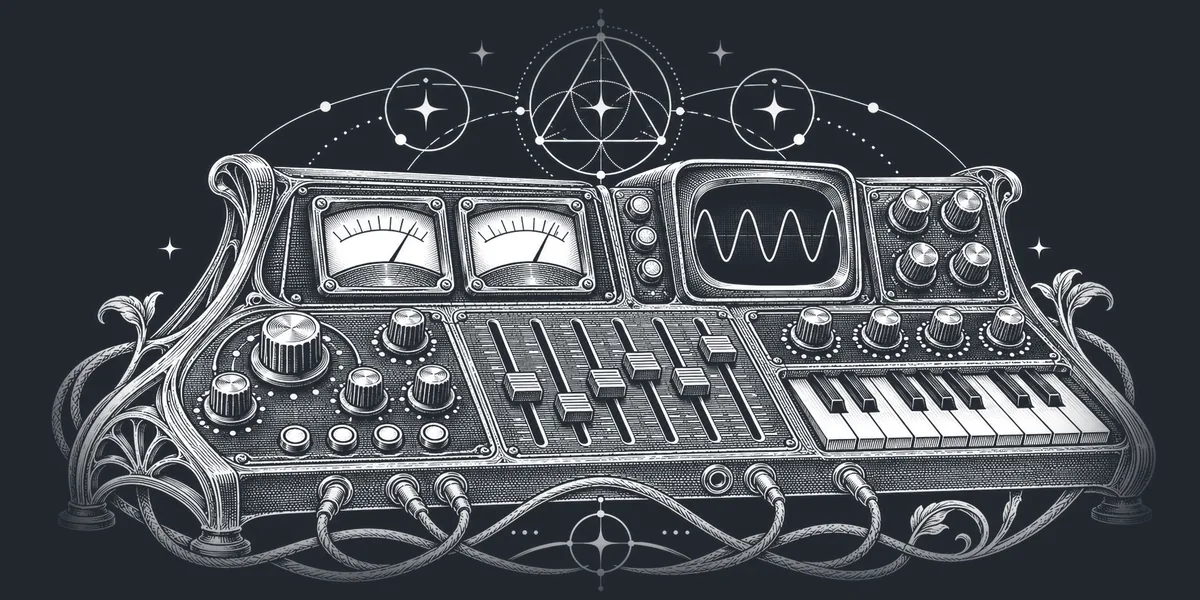
Generic audio UI widgets: meters, knobs, faders, waveforms.
Glyphwork is the component that provides the familiar controls and displays of an audio application. It is part of Signals & Sorcery, a coherent set of Rust audio building blocks for audio apps, plugins, players and DAWs.
| Repository | github.com/shiehn/glyphwork-audio-ui |
|---|---|
| License | MIT, free for commercial and closed-source use |
| Status | Planned |
| Layer | Extend and display (how the layers stack) |
| Crates (planned names) | glyphwork (TypeScript first) |
What it is
Every audio application redraws the same controls: a level meter that doesn't flicker, a knob that drags the right way, a fader with a sensible taper, a waveform that zooms smoothly. Glyphwork is a set of these widgets, done once and done carefully:
- Level meters: peak and RMS, with peak hold and clip indicators, fed by data rather than by polling.
- Knobs and sliders: drag, fine adjust, double-click to reset, keyboard and scroll, with value formatting from the parameter's own units.
- Faders and pan controls: decibel tapers that match the mixer's law.
- Waveform views: precomputed peaks at any zoom, with selection and a play head.
- A piano roll: notes on a grid, with selection, moving, resizing and velocity.
- Transport displays: bars, beats and time, from the engine's transport.
The first target is web technology (TypeScript, for browser and Electron user interfaces). A Rust-native widget set may follow if Rust user interfaces ask for it.
Usage example
Illustrative sketch
Planned, not final. Taken from the README.
import { LevelMeter, Knob, Fader, WaveformView } from "glyphwork";

<LevelMeter source={meters.track(3)} />
<Knob param={cutoff} onChange={(v) => client.setParam(cutoff.id, v)} />
<Fader valueDb={-6} law="mixer" onChange={(db) => client.call("intent.apply", setVolume(track, db))} />
<WaveformView peaks={peaks} playhead={position} onSelect={(range) => setSelection(range)} />
Widgets take display data in and emit editing intentions out. A piano roll doesn't change notes itself: it says "move these notes by one beat", and your application (or an adapter over Grimoire's protocol) turns that into an edit.
How it fits in the ecosystem
Glyphwork is in the extend and display row, beside Familiar. It needs no other component to run. Dependencies point down, never up.
Below it (optional, when used with the rest of Signals & Sorcery):
- its meters read Aethergate (repo)'s shared-memory meters;
- its waveforms draw Scriptorium (repo)'s peaks;
- its edits go through Grimoire (repo)'s protocol.
Beside it: Familiar (repo) panels use it for their controls.
Above it: your user interface.
What it deliberately doesn't do: no audio, no application framework (it is widgets, not a layout system or a state manager), and no engine logic (it reports what the user did; it doesn't decide what an edit means).
| Component | Repository | Role | Status |
|---|---|---|---|
| Runecraft | runecraft-audio-core | Shared contracts, realtime safety, process isolation and realtime-safe logging: the floor every other component stands on | In preparation |
| Orrery | orrery-musical-time | Tempo and meter, transports, bar, beat and sample maths, timed MIDI | In preparation |
| Summoner | summoner-plugin-host | Out-of-process VST3 and Audio Unit plugin hosting with crash isolation | In preparation |
| Aethergate | aethergate-audio-platform | Audio devices (cpal, CoreAudio, a fake device for tests) and shared-memory meters | Planned |
| Leyline | leyline-audio-graph | A realtime audio graph with delay compensation, and a compiler from an edit model to a graph | Planned |
| Cantrips | cantrips-audio-dsp | Built-in mixer DSP: sampler, fader, pan, meters, compressor | Planned |
| Scriptorium | scriptorium-audio-media | Decode and encode, a sample store, streaming voices, crash-safe recording | Planned |
| Tapestry | tapestry-session-model | Tracks, clips, lanes and scenes; edits with undo; a crash-safe project store | Planned |
| Procession | procession-timeline-engine | What plays in each block: regions, notes, automation, launches | Planned |
| Grimoire | grimoire-daw-engine | The assembled engine and its headless JSON-RPC protocol | Planned |
| Familiar | familiar-plugin-sdk | An SDK for plugins and panels that extend a Signals & Sorcery engine | Planned |
| Glyphwork | glyphwork-audio-ui | Audio UI widgets: meters, knobs, faders, waveforms | Planned |
Status
Planned. No code yet. The repository holds the design.
Anywhere a modern browser engine runs: macOS, Windows, Linux and the web. Keyboard control, focus and screen reader labels are part of each widget, and colours, sizes and fonts are themeable tokens.
Links
- Repository: github.com/shiehn/glyphwork-audio-ui (README, LICENSE)
- Reads from: aethergate-audio-platform, scriptorium-audio-media, grimoire-daw-engine
- Beside it: familiar-plugin-sdk
- All twelve components · For agents · llms.txt