Summoner
An out-of-process audio plugin host.
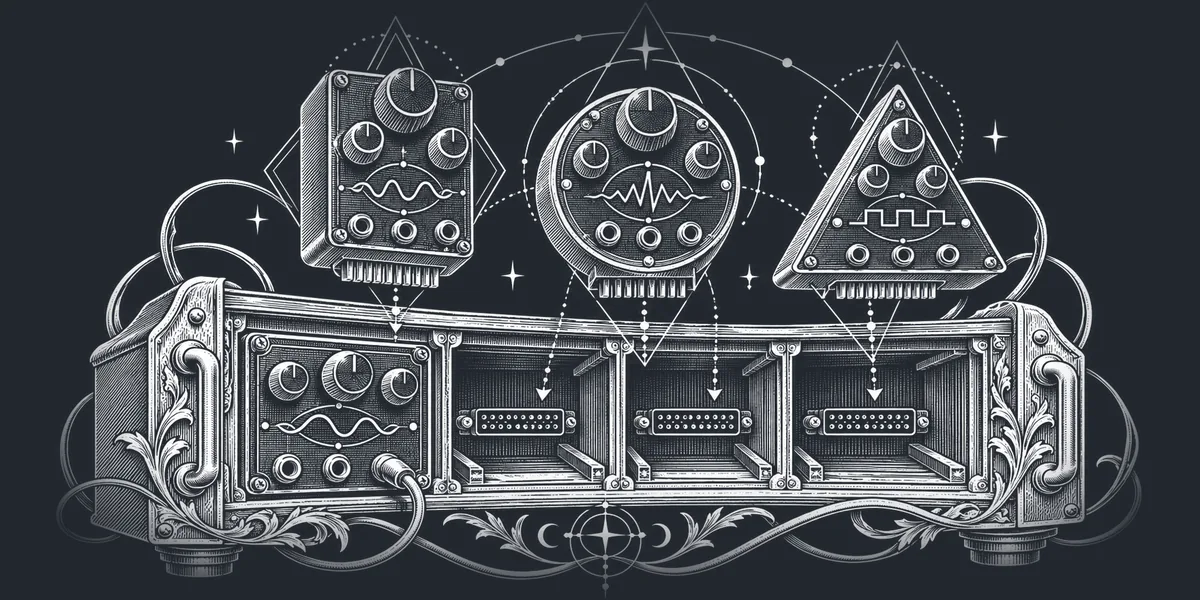
Summoner is the component that loads and runs VST3 and Audio Unit plugins in a separate helper process, so a crashing or hanging plugin can't take your application down. It is part of Signals & Sorcery, a coherent set of Rust audio building blocks for audio apps, plugins, players and DAWs.
| Repository | github.com/shiehn/summoner-plugin-host |
|---|---|
| License | MIT, free for commercial and closed-source use |
| Status | In preparation |
| Layer | Sound and devices (how the layers stack) |
| Crates (planned names) | summoner, summoner-proto, summoner-rt, summoner-scan, summoner-plugin, summoner-testkit |
What it is
Third-party plugins are the least trusted code in any audio application. A plugin can crash, deadlock, leak, take too long or corrupt memory. Inside your process, it takes your process with it. Summoner moves every plugin into a helper process and gives your application a supervised, realtime-safe connection to it.
It has two parts:
- The library links into your application. It spawns and supervises the helper process, talks to it over a control channel, and gives your audio thread one link per plugin chain.
- The host program is a small helper executable that ships with your application. It loads the plugins, runs their audio on its own realtime threads, and owns their editor windows.
What it handles:
- Scanning. Each plugin is probed in its own short-lived process, with a time budget. A plugin that crashes or hangs during a scan is recorded as such and never stops the scan.
- Loading chains. Ask for a chain of instruments and effects and get back a realtime link once every slot is loaded and prepared.
- Realtime block exchange. Audio, MIDI, parameter changes and the transport pass through shared memory, with a doorbell to wake the other side. The audio thread never blocks, locks or allocates.
- State. Plugin state is read and written as versioned, framed blobs. On save, only slots whose state changed are read back, inside a time and byte budget.
- Parameters and editors. Parameters are read in pages and set by the plugin's own id. Editor windows open and close in the helper process.
- Offline render. A synchronous, one-block-at-a-time mode, so bounces use the same plugins and code as live playback.
- Failure handling. Crashes, hangs and protocol faults are detected, reported as events and recovered from. The helper respawns with backoff, chains reload with their last known state, and a plugin that keeps crashing is quarantined.
Usage example
Your application talks to Summoner through two bounded queues: commands in and events out. Sending a command never waits. A full queue returns "busy" at once.
Illustrative sketch
This is the planned shape of the public API, taken from the README. It is not final.
use std::sync::{mpsc, Arc};
use summoner::{ChainSpec, Command, Config, Event, Host, PluginRef};

// Start the supervisor. It spawns the helper process and does the handshake.
let (events_tx, events) = mpsc::sync_channel(4096);
let config = Config::new("path/to/summoner-host".into(), 48_000.0, Arc::new(MyStateHasher));
let host = Host::start(config, events_tx)?;

// Ask for a chain: one instrument followed by one effect.
let spec = ChainSpec::stereo()
    .slot(PluginRef::vst3("/Library/Audio/Plug-Ins/VST3/MySynth.vst3", synth_class_id))
    .slot(PluginRef::audio_unit(effect_type, effect_subtype, effect_manufacturer));
host.send(Command::Load { key: 1, spec, states: vec![] })?;

// React to what happens, on your control thread.
for event in events {
    match event {
        Event::ChainReady { key, link, slots, .. } => audio.install(key, link, slots),
        Event::ChainDown { key, reason } => audio.silence(key, reason),
        Event::StateRead { key, slot, blob, .. } => project.store_state(key, slot, blob),
        _ => {}
    }
}
On the audio thread, a chain's link is called once per block:
fn process(&mut self, io: &mut AudioIo, midi: &[TimedMidi], transport: &Transport) {
    // No allocation, no lock, no blocking: one shared-memory exchange and at most one wake.
    self.link.exchange(io, midi, transport);
}
If the helper misses a deadline, the block is filled with silence (or the dry input, for an effect) and counted. Your audio thread is never held up.
Failures are part of the API
| What happens | What Summoner does | What your application sees |
|---|---|---|
| The helper crashes | respawns it with backoff, reloads every chain with its last known state | ChainDown, then ChainReady again |
| A plugin crashes the helper | blames that slot and quarantines the plugin as an empty pass-through | the chain comes back with that slot marked quarantined |
| The helper stops answering | the wedge detector kills it and treats it as a crash | ChainDown with reason wedge |
| The helper speaks another protocol version | refuses it and doesn't respawn | ChainDown with reason incompatible |
The summoner-testkit crate holds a test double of the host program. It speaks the real protocol over trivial DSP, and knobs make it crash, hang or run slow, so your tests can cover every failure path without a single third-party plugin.
How it fits in the ecosystem
Summoner sits in the sound and devices row. Dependencies point down, never up.
Below it (what it depends on), only the floor:
- Runecraft (repo) for the log contract, the realtime helpers and the process and shared-memory primitives. Every Summoner crate is
#![forbid(unsafe_code)]; the system calls live in Runecraft. - Orrery (repo) for the transport it passes to plugins: tempo, position, loop points and bar start.
Above it (what can use it):
- Leyline (repo) wraps a chain link as a graph node, through an optional adapter.
- Grimoire (repo) wires plugin chains into a full engine, with Summoner as its default
PluginHost.
Neither is required. An effects rack, a batch processor or a plugin test rig can use Summoner with nothing else from Signals & Sorcery.
What it deliberately doesn't do: no audio graph or mixing (that is Leyline), no audio devices (your app or Aethergate owns the device), no project model, and no plugin authoring (crates such as nih-plug and clack serve that well).
| Component | Repository | Role | Status |
|---|---|---|---|
| Runecraft | runecraft-audio-core | Shared contracts, realtime safety, process isolation and realtime-safe logging: the floor every other component stands on | In preparation |
| Orrery | orrery-musical-time | Tempo and meter, transports, bar, beat and sample maths, timed MIDI | In preparation |
| Summoner | summoner-plugin-host | Out-of-process VST3 and Audio Unit plugin hosting with crash isolation | In preparation |
| Aethergate | aethergate-audio-platform | Audio devices (cpal, CoreAudio, a fake device for tests) and shared-memory meters | Planned |
| Leyline | leyline-audio-graph | A realtime audio graph with delay compensation, and a compiler from an edit model to a graph | Planned |
| Cantrips | cantrips-audio-dsp | Built-in mixer DSP: sampler, fader, pan, meters, compressor | Planned |
| Scriptorium | scriptorium-audio-media | Decode and encode, a sample store, streaming voices, crash-safe recording | Planned |
| Tapestry | tapestry-session-model | Tracks, clips, lanes and scenes; edits with undo; a crash-safe project store | Planned |
| Procession | procession-timeline-engine | What plays in each block: regions, notes, automation, launches | Planned |
| Grimoire | grimoire-daw-engine | The assembled engine and its headless JSON-RPC protocol | Planned |
| Familiar | familiar-plugin-sdk | An SDK for plugins and panels that extend a Signals & Sorcery engine | Planned |
| Glyphwork | glyphwork-audio-ui | Audio UI widgets: meters, knobs, faders, waveforms | Planned |
Status
In preparation. The crates exist and are tested, but they live in another repository today. The repository holds the README until the first public release. The public API is still being reviewed, so names and signatures may change.
| Platform | Plugin formats | Status |
|---|---|---|
| macOS (Apple silicon) | VST3, Audio Unit | where it runs today |
| Windows | VST3 | planned |
| Linux | VST3 | planned |
| Any | CLAP | planned |
An in-process mode, for simple tools that would rather trade isolation for simplicity, is planned behind the same API. WebAssembly is out of scope (a browser can't load native plugins), but a web build could drive a native Summoner through Grimoire's protocol.
Links
- Repository: github.com/shiehn/summoner-plugin-host (README, LICENSE)
- Depends on: runecraft-audio-core, orrery-musical-time
- Used by: leyline-audio-graph, grimoire-daw-engine
- All twelve components · For agents · llms.txt
VST is a registered trademark of Steinberg Media Technologies GmbH. Audio Unit is a trademark of Apple Inc.