Procession
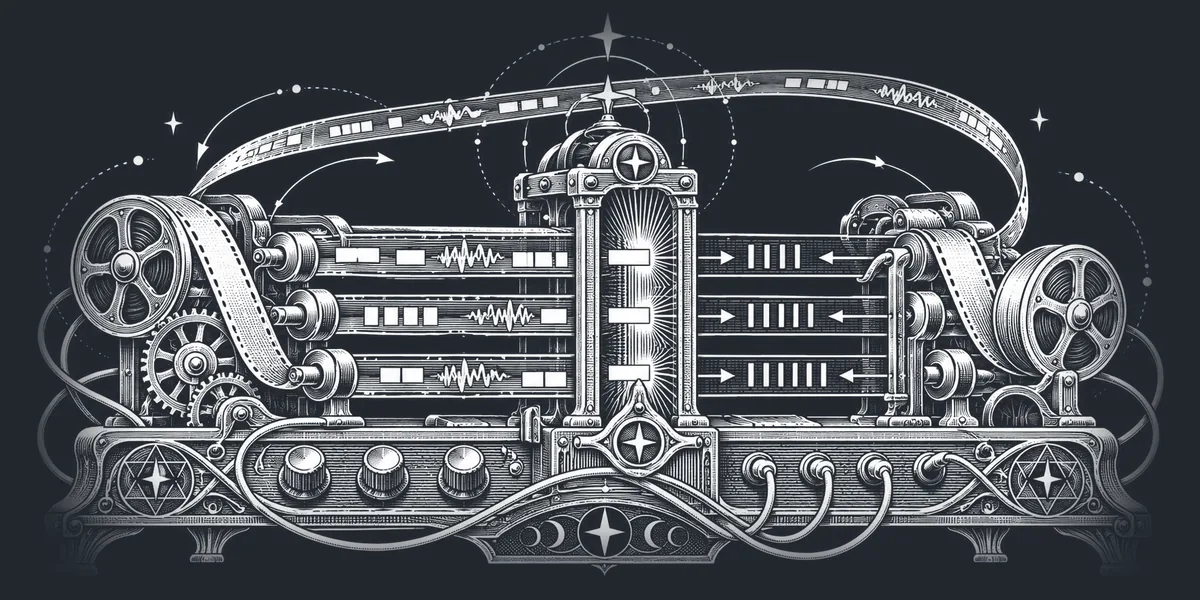
The timeline engine: what plays in each interval, and a conductor for clip and scene launching.
Procession is the component that decides which regions, notes, automation and launches fall inside each block of audio. It is part of Signals & Sorcery, a coherent set of Rust audio building blocks for audio apps, plugins, players and DAWs.
| Repository | github.com/shiehn/procession-timeline-engine |
|---|---|
| License | MIT, free for commercial and closed-source use |
| Status | Planned |
| Layer | Musical structure (how the layers stack) |
| Crates (planned names) | procession |
What it is
Between "the project says this clip starts at bar 9" and "the sampler starts this voice at frame 37 of this block" there is a layer of careful timing work. Procession is that layer.
- Regions. Which audio regions overlap a block, at which sample offset each starts and stops, and where its fades fall.
- Notes. Which MIDI notes start and end in a block, at exact offsets, including notes already sounding when playback starts or jumps.
- Automation. Curve values at block and sub-block resolution, delivered as timed parameter changes.
- Loops, seeks and tempo changes. A block that crosses one is split at the right sample, so nothing drifts.
- The conductor. Quantised launching of clips and scenes: a launch requested now lands on the next bar, beat or grid line, with follow rules for what plays after.
Its input is a compact playback description (regions, notes, curves and launch rules), much smaller than a full project. A simple stem player, a game's music system or a sequencer can use Procession without any session model at all.
Usage example
Illustrative sketch
Planned, not final. Taken from the README.
use procession::{Playback, Region, Conductor, LaunchQuantum, BlockEvents};

let mut play = Playback::new(tempo_map, 48_000.0);
play.add_region(Region::audio(source_id, Bars(1)..Bars(9)).fade_in_ms(5.0));
play.add_notes(track_id, notes);
play.add_curve(param_id, volume_curve);

let mut conductor = Conductor::new(LaunchQuantum::Bar);
conductor.launch_scene(scene_b);                   // lands on the next bar

// Per block (allocation-free once prepared):
let events: BlockEvents = play.block(position, 256, &mut conductor);
for e in events.iter() {
    // start a voice at e.offset, set a parameter at e.offset, stop a note at e.offset ...
}
How it fits in the ecosystem
Procession is in the musical structure row, beside Tapestry. Dependencies point down, never up.
Below it: Orrery (repo) for tempo maps and transports, and Runecraft (repo) for the handoffs that bring a new description to the audio thread. Its events drive the players in Leyline (repo)'s graph and the sources in Scriptorium (repo).
Beside it: Tapestry (repo). The two don't depend on each other.
Above it: Grimoire (repo) builds the playback description from a Tapestry project and runs one playback per transport.
What it deliberately doesn't do: no editing (that is Tapestry's job), no audio processing (Leyline and Cantrips make the sound), no file reading (it asks Scriptorium for ranges), and no time-stretch algorithm.
| Component | Repository | Role | Status |
|---|---|---|---|
| Runecraft | runecraft-audio-core | Shared contracts, realtime safety, process isolation and realtime-safe logging: the floor every other component stands on | In preparation |
| Orrery | orrery-musical-time | Tempo and meter, transports, bar, beat and sample maths, timed MIDI | In preparation |
| Summoner | summoner-plugin-host | Out-of-process VST3 and Audio Unit plugin hosting with crash isolation | In preparation |
| Aethergate | aethergate-audio-platform | Audio devices (cpal, CoreAudio, a fake device for tests) and shared-memory meters | Planned |
| Leyline | leyline-audio-graph | A realtime audio graph with delay compensation, and a compiler from an edit model to a graph | Planned |
| Cantrips | cantrips-audio-dsp | Built-in mixer DSP: sampler, fader, pan, meters, compressor | Planned |
| Scriptorium | scriptorium-audio-media | Decode and encode, a sample store, streaming voices, crash-safe recording | Planned |
| Tapestry | tapestry-session-model | Tracks, clips, lanes and scenes; edits with undo; a crash-safe project store | Planned |
| Procession | procession-timeline-engine | What plays in each block: regions, notes, automation, launches | Planned |
| Grimoire | grimoire-daw-engine | The assembled engine and its headless JSON-RPC protocol | Planned |
| Familiar | familiar-plugin-sdk | An SDK for plugins and panels that extend a Signals & Sorcery engine | Planned |
| Glyphwork | glyphwork-audio-ui | Audio UI widgets: meters, knobs, faders, waveforms | Planned |
Status
Planned. No code yet. The repository holds the design.
Pure Rust: macOS, Windows and Linux. WebAssembly is a natural fit for web and mobile players and is a planned exploration.
Links
- Repository: github.com/shiehn/procession-timeline-engine (README, LICENSE)
- Depends on: orrery-musical-time, runecraft-audio-core; drives leyline-audio-graph and scriptorium-audio-media
- Used by: grimoire-daw-engine
- All twelve components · For agents · llms.txt